
Wednesday Wisdom 4/15
Midweek reads full of fun facts to contemplate on accelerating inflation and economic progress

In Big News, consumer prices are rising at an accelerated pace. I discuss the latest headline number and separate the year-to-date trend.
Reads this week offer complimentary coverage on factors affecting affordability from war to healthcare to labor rights. I also share fun facts about economic progress as measured by the fertility rate.

Big News
As headlines and pundits have made clear since last Friday, inflation is up. The number at the center of this discourse is 3.3 percent, which is year-over-year consumer price (CPI) inflation as of March 2026. Core CPI inflation (excluding food and energy) was up less, at 2.6 percent because it was an energy price spike that drove up inflation.
This year-over-year inflation trend through March 2026 hides a starkly different trajectory in 2026 versus last year. In 2025, CPI inflation was 2.7 percent. In January and February 2026, inflation accelerated to a three-percent annualized trend. On February 28, 2026, the U.S. and Israel started a war with Iran.
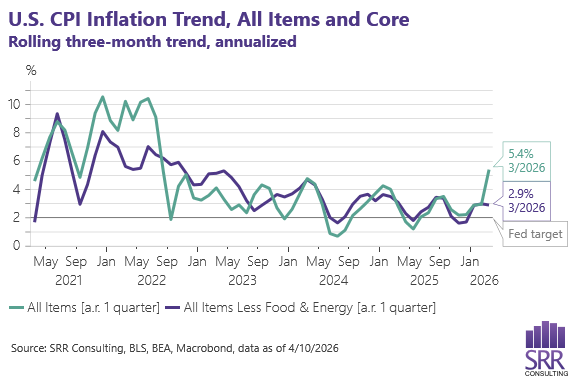
The March 2026 CPI is 0.9 percent higher than February, for the largest monthly inflation since November 2021. Over the first three months of 2026, consumer prices increased at a 5.4 percent annualized pace.
So what? Inflation in 2026 will be higher than last year. My base case forecast (as of March) is that annual inflation will be under four percent, but risk is weighted to the upside.
The first day of that ‘two-week ceasefire’ was the bloodiest day of Gulf War III. This week, the U.S. began a blockade of the Strait of Hormuz. Structural change is all around us, from how the U.S. government operates to who Persian Gulf states can trust, and none of it lowers prices.
I suppose a forecast refresh is warranted. Again.
Reads Around the Web
War will drain the Gulf’s $6trn treasure chest, The Economist, April 15, 2026: ”Bahrain, Kuwait, Oman, Qatar, Saudi Arabia and the United Arab Emirates (UAE) have between them deployed more than $430bn in capital since 2021. For every petrodollar they invest, 75 petrocents ends up abroad… in everything from artificial-intelligence darlings and private credit to Premier League football clubs and TikTok. They oversee over $5trn of assets globally… more of their money will go to rebuilding the old economy rather than erecting a new one.”
Millions of Floridians Will Bear the Brunt of Trump’s Health Cuts, by Miquéla V Thornton and John Tozzi, Bloomberg, April 14, 2026: “While the federal cutbacks are forcing many Florida households to make difficult decisions about how much health care they can afford, hospitals and health systems around the state are facing similar hard choices… Nationally, hospitals could see $68 billion in lost revenue and reimbursements this year and in 2027… Florida accounts for an estimated $8.8 billion of that, second only to Texas among US states.”
Women in Their 20s May Not Be Having Babies, but by 45 Most Probably Will, by Claire Cain Miller, The New York Times, April 9, 2026: ”One of the biggest drivers of the delay in childbearing is widely considered to be a success story: the decline of teen pregnancy… teenage pregnancy has fallen 72 percent, accounting for nearly a third of recent fertility declines… In Southern states, where teen pregnancy was highest, the drop accounts for even more of the recent declines… half in Kentucky, and nearly 50 percent in Alabama, Louisiana and Mississippi.”
Reads on Substack
“…most teens are impregnated by adult men.”
“…the birthrate obsession is less about babies and more about female submission.”
“If you decide that you will love humanity then the choices that follow will make themselves.”


Three Related Fun Facts Reads:


One Last Thing…
…well, two things. First, the fertility discourse on my LinkedIn feed is infuriating.
As a person with a uterus, I have fewer rights in America today than I did when I was born fifty years ago. Meanwhile, a growing contingent of economists without a uterus have determined that making more babies will solve all America’s problems. I expect better from my peers.
Economists who believe falling fertility rates are a crisis need to reopen their dusty economic development textbooks. As any nation moves toward open, equitable participation in its government and economy, birth rates fall. My field of economic study calls this progress.
Every child deserves to be wanted, afforded, and planned.
And now, a salute to bodily autonomy🫡
Sara’s Fun Facts Schedule
🦉 4/22 Wednesday Wisdom: Q1 Real Estate Performance Preview
🦉 4/29 Wednesday Wisdom: State-level Jobs Update
🦉 5/6 Wednesday Wisdom: GDP Growth
🌆 5/11 SRR Real Estate Quarterly: Q1 2026
“The most revolutionary thing one can do is always to proclaim loudly what is happening.” — Rosa Luxemburg
Cheers! - Sara 🦉