
Wednesday Wisdom 5/13
Midweek reads full of fun facts to contemplate on jobs, layoffs, and daycare

In Big News, the unemployment rate is stable for bad reasons and healthcare jobs are everything. I dig into April labor market conditions with data from multiple sources.
The article round-up includes the latest survey on U.S. business activity, warnings for investors, American malaise, and our pool. Stick around for Donny’s Daycare in One Last Thing.

Big News
Last Friday, the BLS reported on the April 2026 Employment Situation, reporting a net payroll job gain of 115,00 jobs for the month and no change in the unemployment rate. The rolling three-month trend in jobs gains has held in the 0-to-50,000 jobs per month range so far this year. This pace is estimated to be the new ‘breakeven’ level required to keep unemployment stable under zero-immigration policy1.
The stable 4.3 percent unemployment rate in April is unfortunately the result of rising unemployment offset by declines in both the labor force participation rate and the employment-to-population ratio. Fewer people are employed, but fewer people are looking for work because they cannot find a job. Yikes.
Employers announced 83,400 layoffs in April, according to Challenger, Gray & Christmas, for a total of 300,700 layoffs in the first four months of 2026. Nearly half of year-to-date layoff announcements are in the tech, transportation, and healthcare sectors. The top three reasons cited for year-to-date layoffs are economic conditions, firm closures, and artificial intelligence. No wonder it’s tough to find a job.
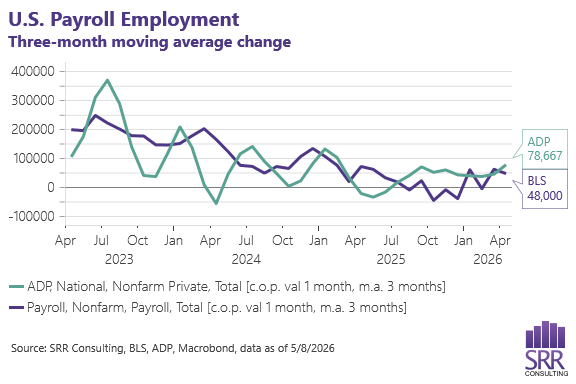
Private payroll employment gains from ADP are running slightly ahead of the BLS over the three-months ending in April, at 78,700 new jobs per month. The difference makes sense because ADP excludes public sector employment and government employment has contracted by 21,000 jobs over the past three months.
Healthcare is still the key driver of U.S. job growth. ADP cited the sector as leading growth while BLS employment in the sector increased by 53,900 jobs in April. The net year-to-date gain of nearly 300,000 jobs in the BLS report accounts for 98 percent of all jobs added in the first four months of 2026.
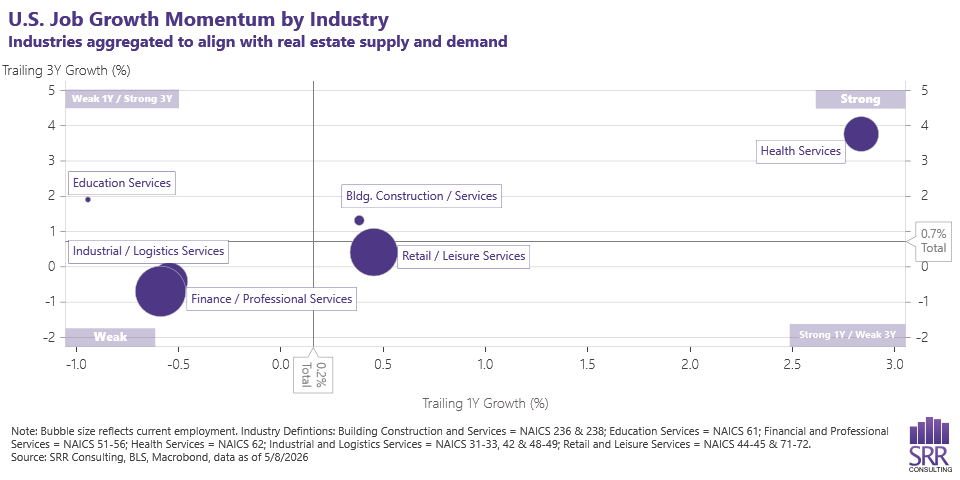
As shown in the chart above, healthcare is not only the strongest employment sector over the past year, but also over the past three years. This bubble chart explores employment momentum in categories that SRR Consulting organizes to align with real estate demand. Let’s dig into the three largest industry sectors:
Finance / Professional Services. The largest of these industry groups, at 34 million jobs, has been shrinking for three years. In April, information and financial activities contracted by a combined 24,000 jobs, while professional and business services eked out a 7,000-job gain. Within the broad professional/business services category, gains in consulting, engineering, and legal services offset monthly losses in management, scientific, and administrative services.
Retail / Leisure Services. At 32 million jobs, this group includes retail trade, leisure, and hospitality employees. Retailers added 21,800 jobs in April, but this expansion is concentrated among discounters and building material/garden stores. Leisure services are holding up well this spring with restaurants/bars and performing arts/sports venues adding jobs, but hospitality remains under pressure. Accommodation employment is down by 27,100 jobs over the past year with more than half those losses occurring in April 2026.
Industrial / Logistics Services. This group of 25 million jobs includes warehousing, transportation, and wholesale trade. Like finance/professional services, employment in this group has been shrinking for the past three years. April 2026 seasonal adjustments to this group boosted the monthly gain in couriers to an eye-popping 37,900 jobs and flipped warehouse employment to stable from a decline in the unadjusted data. A slow deterioration of employment in this group will likely continue due to rising costs and warehouse automation.
So what? Economic expansions dependent upon a single sector are not sustainable. In the U.S. today, output growth is balancing entirely on AI infrastructure investment, and payroll employment growth is dependent on health services expansion.
Reads Around the Web
NABE Survey Results Show Costs Have Risen Amid Middle East Conflict, Constraining Profits and Dampening Plans for Investment and Hiring, National Association for Business Economics (NABE), May 11, 2026: “Materials costs are on the rise… Wage growth is abating… Employment growth slides… the share of panelists reporting higher levels of employment in the May survey versus lower headcount decreased to its lowest level since October 2023… Energy prices, input, or transportation costs are cited by a majority (54%) of panelists as effects of the Middle East conflict on their businesses.”
Michael Burry Warns of Stock Crash as Tech Jump Echoes 2000 Peak, by Jess Menton, Bloomberg, May 11, 2026: “the Nasdaq 100, by his reckoning, is trading at 43 times earnings… because ‘Wall Street may be overstating by more than 50% the earnings at our fastest growing, most highly valued companies’… Burry is among a number of market observers who have expressed concerns about the rally unleashed by the artificial-intelligence spending boom… That’s pushed indexes to record highs even as the US war against Iran threatens to both slow growth and fan inflation.” (Michael Burry’s Substack Post)
Meet the academics refusing to use generative AI, by Hannah Docter-Loeb, Nature, May 5, 2026: ”concerns about the ethics of copyright… lack of transparency from companies about how they’re using the data, the environmental effects of AI tools and the accuracy of what genAI models spit out… 90% of respondents felt it was acceptable to use AI for editing or translating their own text, but fewer were open to the idea of using it to generate text… verifying AI-generated information often defeats the purpose of using the tool for efficiency.”
Reads on Substack
“By the time the evidence becomes statistically undeniable, the damage has often already occurred.”
“America’s quality of life is much worse than one would expect given the nation’s wealth. And we should always remember that economic growth is supposed to be the foundation of a better life.”
“This is what happens when a president treats public property as personal property.”


Related Fun Facts Reads:


One Last Thing…
“Spirit Airlines, at least it’s no longer suffering.”
Sara’s Fun Facts Schedule
🌆 5/15 SRR Real Estate Quarterly: Q1 2026
🦉 5/20 Wednesday Wisdom: April Inflation
🦉 5/27 No Wednesday Wisdom: Sara takes a break 🌞
🦉 6/3 Wednesday Wisdom: State-level Employment
“The most revolutionary thing one can do is always to proclaim loudly what is happening.” — Rosa Luxemburg
Cheers! - Sara 🦉
Read more about breakeven job gains in Sunshine Corner 10/2025 and Wednesday Wisdom 10/15.