
Wednesday Wisdom 5/6
Midweek reads full of fun facts to contemplate about single-sector economic growth

In Big News, the economic growth headlines are pretty, but the details should raise alarms about where the U.S. is headed. The article round-up expands on activity in the single sector driving economic growth, including real estate impacts.

Big News
Two percent growth in economic output sounds pretty good. Ten percent growth in business investment sounds pretty damn good. The headlines belie the story, however, and twenty percent growth in data center investment makes the U.S. economy look like a one-legged stool.
Contributions to growth. The bar chart below breaks out major categories of real gross domestic product (GDP) into their share of the two percent annualized total growth for the first quarter of 2026. The shares are the combination of the dollar value and growth rate for each category and, when added together, sum to quarterly growth. It’s a handy way to see what is moving up and down each quarter.
Tech-related business investment was the largest contributor to growth in the first quarter, accounting for 96 percent of total growth with a 1.9 percent contribution, which exceeds the combined 1.8 percent contribution from personal consumption and government spending. These positive contributions were offset by declines in net exports, non-tech business investment, and residential investment.
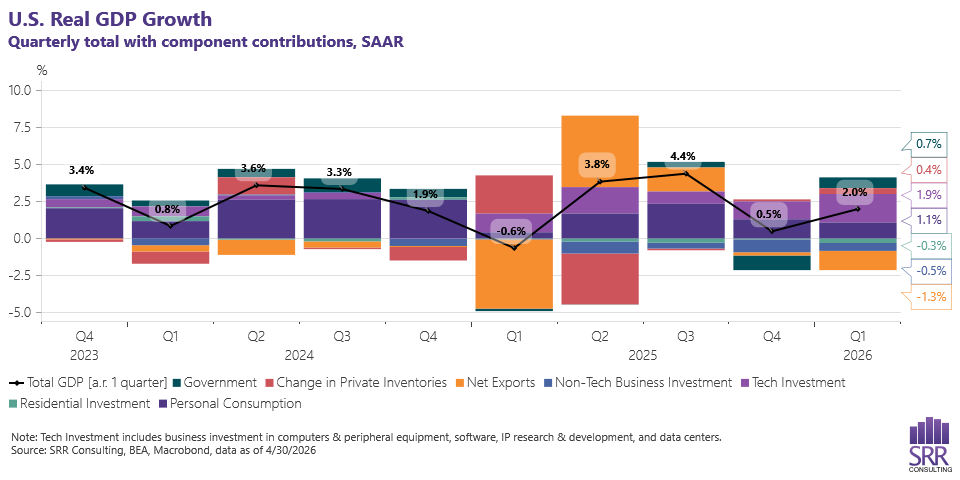
Domestic investment. At the core of U.S. GDP is nearly $17 trillion of personal consumption. I call it the core because consumption accounts for two-thirds of GDP. People spending money is the U.S. economy. People buying homes (residential investment) accounts for $745 billion in the first quarter. In order to spend money and buy homes, people need jobs that pay a living wage.
Business investment connects to job market conditions in multiple ways. Growing investment in structures can indicate expanding production or a need for more office space to house a growing business. Rising investment in computers/electronics can indicate current or future increases in hiring. The ebbs and flows of private domestic investment reveal undercurrents in the economy.
The chart below shows the annual trends for domestic investment and personal consumption growth. The nearly straight line is personal consumption because its size allows for less volatility. Tech-related business investment is growing at an accelerated pace since 2024 and is up nearly eighteen percent over the past year. Non-tech business investment — machinery, vehicles, non-data center structures, etc. — has been shrinking for a year and a half.
The annual growth in tech-related business investment is being driven by artificial intelligence equipment and infrastructure. For the year ending in first quarter 2026, computers and related equipment investment is up 64 percent and spending on data centers to house this equipment increased 24 percent. Tech-related business investment totals $2 trillion in the first quarter, or less than ten percent of total GDP. Due to the declines in non-tech business investment, however, the tech portion of business investment surpassed non-tech investment nine months ago.
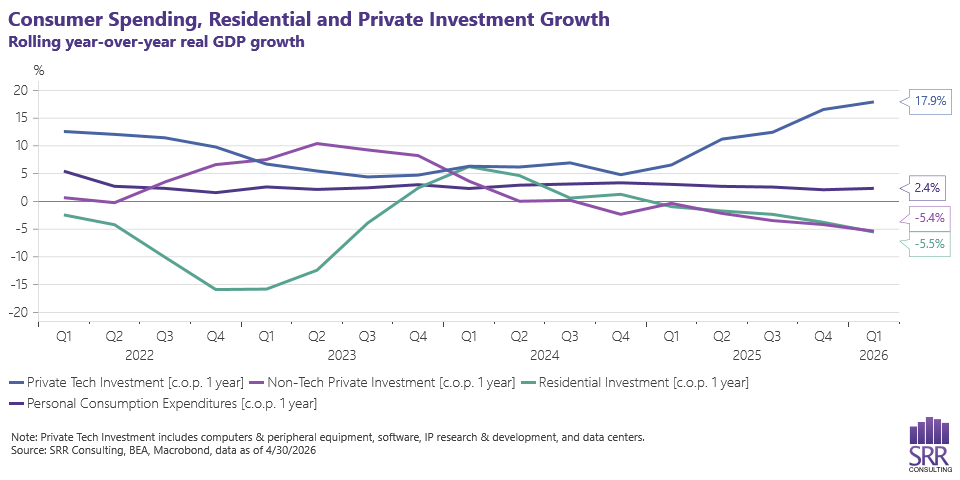
So what? The trend in business investment should be raising alarms about recession or worse, stagflation. Capital-intensive growth is not inherently bad, but it is only good for the rest of us when capital is invested in expansions that create jobs and raise incomes. When the data centers are built, how many jobs will they add?
Reads Around the Web
CBRE Profit Jumps 95%, Fueled By Data Centers, by Billy Wadsack, Bisnow, April 23, 2026: “The world’s largest commercial real estate company increased its net income by more than 95% year-over-year… CBRE’s stock fell about 6% by the early afternoon… the stock’s negative momentum stemming from what analysts have called the ‘artificial intelligence scare trade’… Since February, investors have dumped companies whose business models rely on human expertise and information advantages.”
Local Pushback Slows Data Center Growth Across U.S. Markets, by Philippa Maister, GlobeSt, April 29, 2026: “…communities see the stress the massive land, water and power needs of these facilities impose on once-tranquil neighborhoods, as well as the noise created by massive cooling systems and other equipment that operate throughout the day and increased traffic. As a result, cities and states in many parts of the country have adopted – or are considering adopting – moratoriums on issuing permits for new data centers.”
OpenAI Reportedly Misses Its Own User and Sales Goals, by Debby Wu, Bloomberg, April 27, 2026: “if OpenAI doesn’t increase sales fast enough, it may not be able to afford its future computing needs… There are growing worries among investors that AI developers and Big Tech firms are spending too much on data centers and chips for AI, with an uncertain payoff… OpenAI alone has previously said it’s committed to spend more than $1.4 trillion on AI infrastructure.”
Reads on Substack
“the real driving force of capital accumulation isn’t competition – it’s domination”
“our children’s minds and their creative potentials and their collective emotional wellbeing — not to mention the future wellbeing of our democracy — are all too precious to hand over to brain-numbing AI robots”
“What makes the land valuable isn’t the owner—it’s the location.”


Related Fun Facts Reads:


One Last Thing…
…cousin Daisy’s famous chocolate cake 😉
Sara’s Fun Facts Schedule
🦉 5/13 Wednesday Wisdom: April Employment
🌆 5/14 SRR Real Estate Quarterly: Q1 2026
🦉 5/20 Wednesday Wisdom: April Inflation
🦉 5/27 No Wednesday Wisdom: Sara takes a break 🌞
“The most revolutionary thing one can do is always to proclaim loudly what is happening.” — Rosa Luxemburg
Cheers! - Sara 🦉