
Wednesday Wisdom 6/3
Midweek reads full of fun facts to contemplate on state jobs, healthcare, immigration, and corrupt tales (woo-hoo)

Good day dear readers, I am frazzled.
While analyzing state employment, I discovered more cuts to free and (formerly) reliable federal statistics sites, and this time it’s FRED1. So many visuals are missing from my decades old account that I fell into a rabbit hole trying to find out why.
This morning, I decided to stop searching for what was lost. I can still find the data I need, but my paid resources are becoming more critical to my work.

Big News
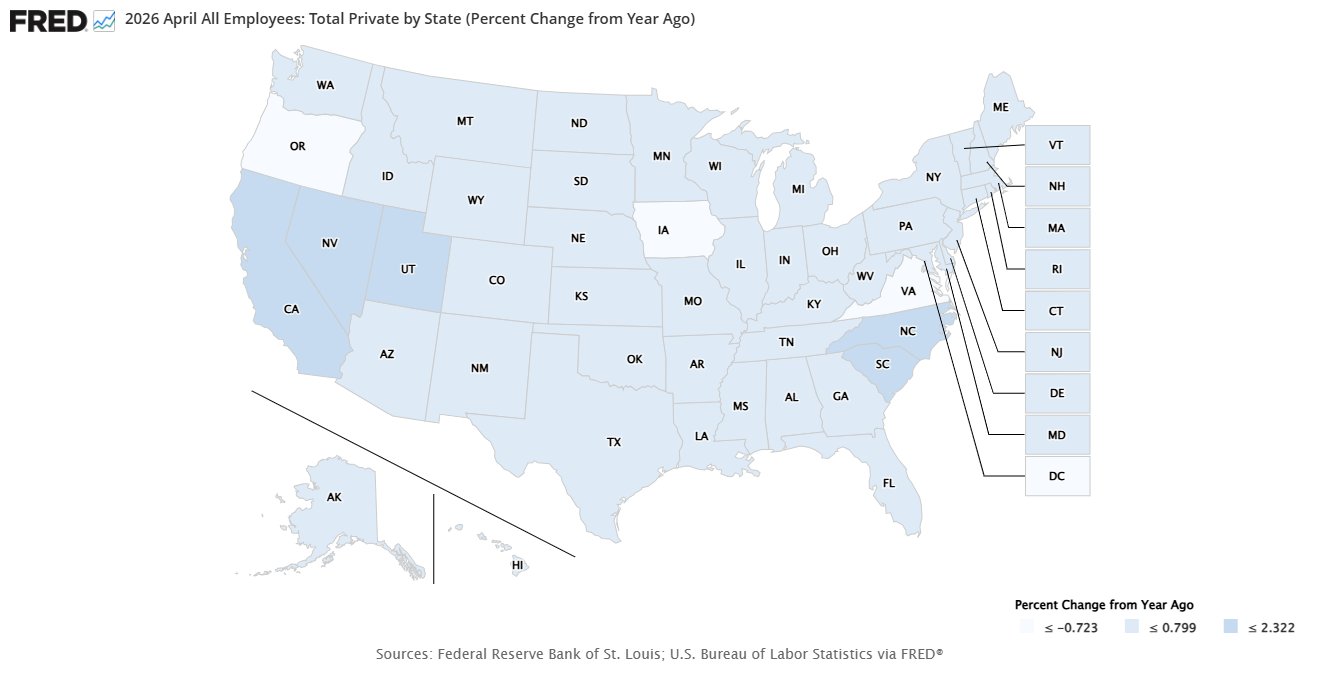
The latest state-level employment data shows limited statistically significant movement in state-level payroll employment. In April 2026, six states had employment gains over the month and only one, Nevada, saw gains over the year.
Small movements in annual payroll employment were more widespread. Twenty-six states reported job increases, while twenty states and Washington D.C. reported declines. There are noteworthy industry employment patterns across these states.
What’s growing? The healthcare and construction sectors were the key to state-level employment gains over the year ending in April 2026.
Healthcare jobs expanded in most areas (all but Alaska and Washington D.C.) with the strongest annual growth in Nevada, Colorado, and California.
Ten states had year-over-year construction employment growth of four percent or higher, led by Louisiana. Thanks to construction job gains, Missouri and Ohio achieved modest total job growth over the year.
Minnesota and the Carolinas stood out for healthy contributions from both the healthcare and construction sectors.
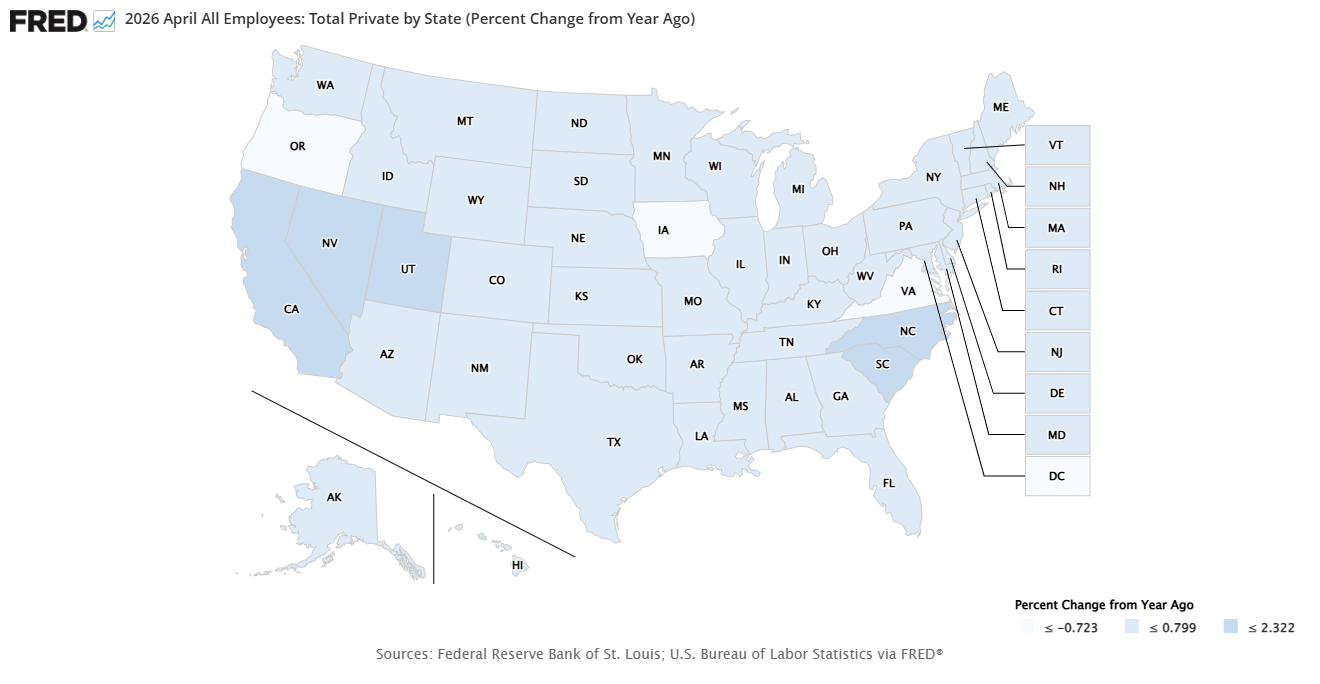
FRED map of total private employment (excludes government) by state. Despite not being able to change the series, I prefer this to the interactive BLS charts because of interval control. The three equal intervals for each color allow for easier identification of states with declining (lightest), stable, or increasing (darkest) employment.
What’s shrinking? Employment declines in the trade/transportation, manufacturing, information, and government sectors are widespread.
National information2 employment peaked in October 2022, at 3.1 million employees, then shed 342,000 jobs through April 2026. Annual jobs in this sector are declining in forty-four states and Washington D.C., with information jobs in ten states contracting by five percent or more. These service jobs are vulnerable to AI adoption.
Manufacturing is in broad decline with tariffs driving up costs and inflation curbing demand. These tariff effects also impact trade and transportation employment in states with sizeable manufacturing, or mining and logging, employment concentrations. Iowa, Oregon, and Wisconsin are feeling this dual impact from reduced manufacturing, while Nebraska is feeling this shift from less natural resource demand.
Deep cuts to government employment and federal research funding are also impacting state labor markets. Thirty-eight states lost government jobs over the past year, while Washington D.C. remains the weakest U.S. job market due to its 11.6 percent annual contraction in government employment.
So what? States managing to eke-out payroll job gains have higher concentrations of healthcare employment and/or lower concentrations of tech-related employment. The labor market is weak and struggling under policies that restrict growth, like tariffs, zero immigration, and healthcare criminalization.
AI investment may be fueling output growth, but job and income growth is required to keep the U.S. economy afloat.
Related Fun Facts Reads:


Reads Around the Web
I wrote that Boomers were choking America’s economy. Their responses to me were revealing, by Nick Lichtenberg, Fortune, May 31, 2026: “Under the rage, what comes through most clearly is fear. Fear of aging, fear of losing status, fear of running out of money, fear of being told that a life spent following the rules now looks like a historical offense… The real lesson is not that one generation is uniquely wicked or uniquely wronged. It is that policy, prices, technology and demographics have built a country and an economy where each cohort experiences the same blockage from a different side. The common refrain is the same: I did what I was supposed to do. I still don’t feel secure.”
Shock, awe, and economic fallout: The employment effects of ICE enforcement in US cities, by Marcela Escobari, Ian Seyal, and Paul Beach, Brookings, May 29, 2026: “The enforcement surge cost 668,000 jobs… ICE made around 52,000 excess arrests… Each excess arrest… is associated with 13 jobs lost overall… between one and six of the jobs lost [per excess arrest] would have been held by American-born workers… Sectors where immigrant workers are heavily represented, such as construction and accommodation and food services, sustained the deepest direct job losses. But industries with very few immigrant workers, such as arts and entertainment, also contracted sharply… consistent with fear-driven demand suppression”
Trump’s Deportations Are Costing Americans Jobs, Study Finds, by Ronda Kaysen, The New York Times, May 19, 2026: ”Recent surges in deportations have led to job losses for both immigrant and American-born workers… researchers focused on four industries that rely heavily on undocumented immigrant workers: agriculture, construction, manufacturing and wholesale… Deportations had a chilling effect on each of those industries, disproportionately affecting men… the affected industries saw a 5 percent drop in employment for male undocumented workers and a 1.3 percent drop for male American-born workers without a college degree. The researchers found no evidence that employers increased wages to attract American workers.” (NBER study)
Reads on Substack
“This is terrific news: Illinois lawmakers passed a bill this weekend that establishes special protections for the medical records of abortion patients.”
“To repeat: the vast majority of people ever held have absolutely zero criminal convictions according to ICE’s own data.”
Some colleagues from my Invesco days started a newsletter. I think you’ll enjoy their insights and opinions, plus “memes are gratuitous and entirely on purpose.”


One Last Thing…
“I bet he’s building the ballroom just so he can do a slip and fall.”
Sara’s Fun Facts Schedule
☀️ 6/8 Sunshine Corner: The Fertility Rate
🦉 6/10 Wednesday Wisdom: May Employment
🦉 6/17 Wednesday Wisdom: Fed Day, late edition
🦉 6/24 Wednesday Wisdom: May Inflation
“The most revolutionary thing one can do is always to proclaim loudly what is happening.” — Rosa Luxemburg
Cheers! - Sara 🦉
FRED is short for Federal Reserve Economic Data. It is a free interface for finding and visualizing federal data that is maintained by the Research Department at the Federal Reserve Bank of St. Louis.
Information includes employment with companies involved in publishing (software, traditional, and internet), motion picture and sound recording, broadcasting (traditional and internet), telecommunications, internet search portals, and data processing.