
Wednesday Wisdom 7/1
Midweek reads full of fun facts to contemplate on bicentennial babies, 1776, and patriotism

Hello Readers,
Celebrating America is tough these days.
Fifty years ago, celebrating America was easier with some big wins before out bicentennial. A president committed crimes, then resigned in shame. Our experiment in self-governance aced that big test. Social equity was improving too, with civil rights legislation and legal confirmation of reproductive rights.
Also in 1976, I was born. Bicentennial babies share an affinity for celebrating America’s birthday. Trinkets and doodads covered with Americana and declaring “Bi-Centennial Baby!” we’re around us in childhood. We connected our age to our country with those bicentennial vibes and hippie parents.
This personal connection is tiny in scope, but difficult to corrupt, like a birthday. Not like an older sibling’s birthday where the younger one demands a present. Yes, we want a parade and fireworks. But… it’s for America. 🤩
Big 1776 News
I have another connection to America’s history. My ancestors signed its founding documents.
I am descended from the Rutledge family line that left South Carolina to go further south. My branch settled in Mississippi. My great grandmother, Alma Cox Rutledge, maintained the lineage of her husband’s (Marvin Sr.) family connections back east. She compiled and printed a booklet for the 1980 family reunion in Brookfield, Mississippi. I always hear her in my ear spelling Mississippi, “…crooked-letter, crooked-letter, i, humpback, humpback, i.”
Her booklet alerted me to the family signatories of the Declaration of Independence, Edward Rutledge, Delegate from South Carolina to the Continental Congress, and U.S. Constitution, John Rutledge, Delegate from South Carolina to the Philadelphia Convention. These brothers were founding fathers and related to me. Wow, cool!
In 7th grade history class, our teacher chose to show us 1776 (Hunt, 1972) as part of our unit on American history. The teacher had to announce this viewing in advance and issue permission slips for parents to consent, or not, for us to watch this dramatized musical about the Declaration of Independence. Texas public schools are weird, y’all.
My mother, in typical fashion, laughed at the permission slip and signed it. She also expressed her appreciation for the musical. I was a big mad tween because I wanted to learn history, not watch musicals about it. I knew my family was involved with founding America and wanted to learn more. The booklet didn’t explain their actions, just the fact of their participation and their place in the family tree.
“Oh, sit down,” my mom said in the only direct quote I recall from our conversation. She prepared me for the musical’s dramatization of the July 1, 1776, delegate walkout.
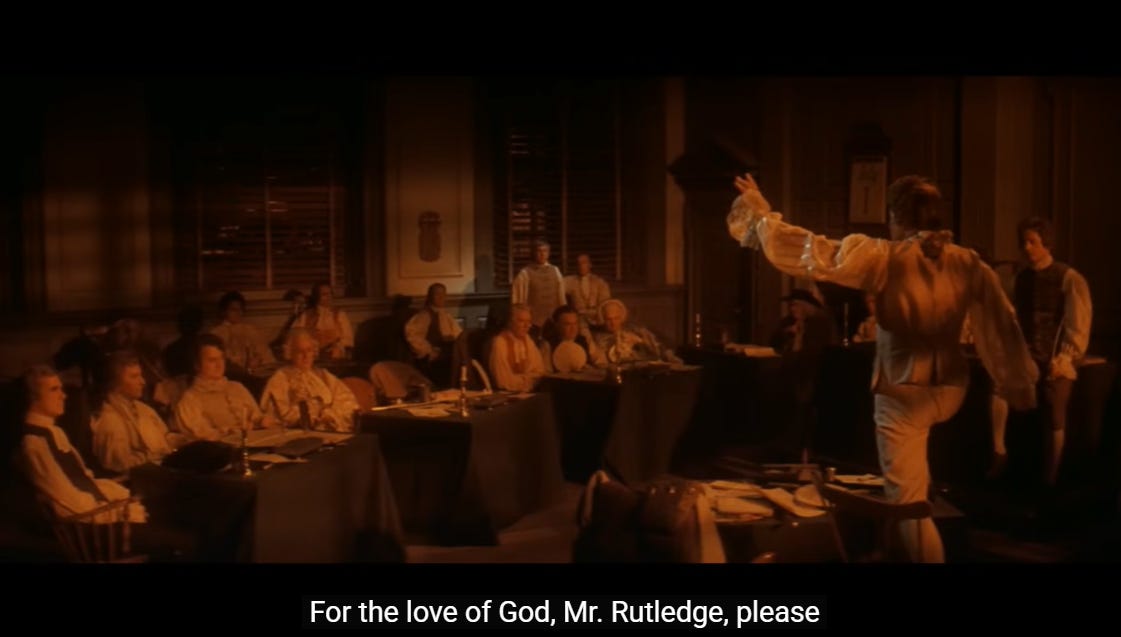
If you’re also a product of a former confederate state’s public school system, you may not know an early draft of the Declaration of Independence would have ended chattel slavery.
Jefferson was writing for much of June 1776 as part of the Committee of Five, which included John Adams (Massachusetts), Benjamin Franklin (Pennsylvania), Robert R. Livingston (New York), and Roger Sherman (Connecticut). He would write drafts for committee review, debating changes over time, until a final draft went to the Continental Congress for a vote.
The last, or 27th, grievance listed in the final Declaration of Independence reads:
“He has excited domestic insurrections amongst us, and has endeavoured to bring on the inhabitants of our frontiers, the merciless Indian Savages, whose known rule of warfare, is an undistinguished destruction of all ages, sexes and conditions.”
This grievance concerns the king compensating indigenous people for carrying out attacks against colonists. An earlier draft was written as:
“He has waged cruel war against human nature itself, violating its most sacred rights of life and liberty in the persons of a distant people who never offended him, captivating & carrying them into slavery in another hemisphere or to incur miserable death in their transportation thither… he is now exciting those very people to rise in arms among us, and to purchase that liberty of which he has deprived them, by murdering the people on whom he has obtruded them: thus paying off former crimes committed again the Liberties of one people, with crimes which he urges them to commit against the lives of another.”
Though there is limited information about the Committee of Five discussion, we know the abolition of “captivating & carrying them into slavery” would not be accepted by southern colonies. What we can’t be certain about is which committee members had, or had the strongest objections, to what Jefferson wrote in this earlier draft.
On July 1, 1776, John Dickinson (Pennsylvania) gave a speech to dissuade the convention from declaring independence at all. The delegates from Pennsylvania and Delaware walked out. Edward Rutledge proposed the vote be delayed another day and schmoozed with delegates to get the thing passed. On July 2, 1776, the unanimous vote for independence was taken.
Smashing these events together, the 1972 film shows Rutledge leading a walkout to protect slavery. The character of Mr. Rutledge signing salaciously about the horrors of slavery lining the pockets of delegates at the Continental Convention is inaccurate, but as his ancestor, I think it’s fair.
My ancestors were slave owners and would not have joined other colonies in starting this 250-year experiment in self-governance if abolition was on the table. I feel I must right the wrongs of my ancestors. To build a truly free and equitable society. To me, the fight for equity and self-governance is personal. 🗽
Related Fun Facts Reads:


Reads Around the Web
Letter: The fight for reparations must go on, by Rev. Eileen Wiviott et. al., Evanston Roundtable, June 23, 2026: “Evanston has been a leader of a movement to engage in the repair of our nation’s most egregious sins, which have mutated and perpetuated harm in countless, insidious ways… The federal government has no right to undo what we, in Evanston, have engaged in, fought for, committed to, and understand as a necessary part of our collective liberation. We decry the efforts by our national leaders to undermine our sacred right to dismantle white supremacy in all its evil forms.”
Five Words That Changed America, by Jamelle Bouie, The New York Times, July 1, 2026: “It was their Declaration — the one that they made for themselves — that stood for a universal claim of human equality in the here and now. And it was their Declaration that would come to supplant Jefferson’s historical and metaphysical one as the linchpin of America’s civic ideal, passing from Black Americans to abolitionists to the Republican Party and Abraham Lincoln, who consecrated their Declaration at Gettysburg as the spiritual foundation for a “new birth of freedom” and a “government of the people, by the people, for the people,” established “four score and seven years ago” in 1776.”
”How Americans see their country’s past, present and future, The Economist, June 29, 2026: ”The republic was built on Enlightenment principles such as liberalism, natural rights and self-government. The Declaration of Independence proclaimed that “all men are created equal”; the constitution enshrined freedoms of speech, religion and assembly. America has never kept all its promises—many of the founders, after all, owned slaves. Yet after 250 years almost 60% of respondents believe the country has strayed from its founding principles, including majorities of both Republicans and Democrats.”
Reads on Substack
“The truth is, a Fed chair isn’t a wizard.”
“Accumulation of wealth is bad for job growth, economic stability, and democracy.”
“When he’s right, he’s right. Even when he doesn’t know why.”


One Last Thing…
“What the hell are you talking about?”
Sara’s Fun Facts Schedule
☀️ 7/8 Sunshine Corner 7/2026: Metro Employment, One Year After Liberation Day
🦉 7/15 Wednesday Wisdom: June Jobs and Prices
🦉 7/22 Wednesday Wisdom: Consumer Credit
🦉 7/29 Wednesday Wisdom: Fed Day
“The most revolutionary thing one can do is always to proclaim loudly what is happening.” — Rosa Luxemburg
Cheers! - Sara 🦉