
Sunshine Corner 3/2026
War changes everything.

My plan for Sunshine Corner this month was an update on how U.S. consumers were faring under current economic conditions. I will still touch on this, but new framing for economic conditions is needed because war changes everything.
War should be a last resort, reserved for halting wholesale evil, like genocide. Starting a war without an exit plan is ignorant. The U.S. and Israel starting this cascade of wars in the Middle East is dangerously shortsighted, but here we are.

Why am I like this?
“Is daddy coming home,” I asked my mom for the first, but not the last, time in 1979. I can’t remember watching television before this day, despite feeling certain that Sesame Street was on my radar by my third year.
The U.S. embassy in Iran was stormed and the staff, mostly Americans, were taken hostage. Evening news and political events were required viewing, especially on this day. My mother clarified that father was in process of evacuating the region as we watched the footage. I don’t recall which country he was fleeing this time, and it doesn’t matter now. The risks of my father’s overseas upstream energy work meant a clear-eyed education on the world according to OPEC.
In elementary school, my Iranian friend taught me to write my name in Farsi. We worked at her desk, beneath a photo of the Ayatollah, while her older brother studied separately, and the women of the house toiled away in the kitchen. The spices floated into my language lesson, sparking my after-school appetite with an unfamiliar blend versus the Creole heat at my house.
I was a latchkey kid. She had strict rules for after-school studies, including weekly public library time. We both had straight-As but culturally, I was an American ‘bad influence.’ At the library, with her brother as chaperone, I engineered our clandestine escapes to the adjacent mall for fifty-cent ice cream cones. We would eat them by the wishing fountain, then hurry back before he noticed we were gone.
In 1990, my father was working in Syria and had to evacuate via Germany. Our president – the first of the Bushes – chose to briefly invade Iraq, abruptly ending the need for repairs on the refining facility previously bombed by Iraq.
My high school history teacher tried to provide a rah-rah explanation of the war in class, only to find my face contort with smirky sadness. I told her about the late-night satellite call with loud static where I could barely piece together where my father was going, although it was clear he was leaving the region. Again.
I graduated from the Texas Academy of Mathematics and Science in 1994, during a civil war in Yemen. My father was unable to attend because the airport was destroyed. He made it home later that summer. I am fortunate that he always made it home.
I wrote a college paper about the Yemeni people. Their culture, their lives were torn apart by war, and I wanted to share context for this place most Americans can’t find on a map. As a student of economic development, I saw a path forward for Yemen, probably because I was naive. After multiple decades of fresh wars, I now see how this as unlikely in my lifetime.
One of the kindest economists I’ve met is from Gaza, my Palestinian friend from graduate school. As a research assistant, I had an interior office, smaller than the one hundred square feet I’m occupying now. I shared my office keys with him as a private space for midday prayer. I have not kept touch with school friends as well as I should, but I regret losing my connection with him the most. He earned an economics degree alongside me, excited to return and contribute to developing a free Palestine. I hope he is safe, but recognize those odds are slim.
Never think that war, no matter how necessary, nor how justified, is not a crime. — Ernest Hemingway, For Whom the Bell Tolls (1940)
Inflation chips away at consumption.
On an annual basis, consumer price inflation drifted down to 2.4 percent as of January 2026 from a peak of nearly nine percent in June 2022. The sharp increase in prices that year began with an energy price shock as Russia invaded Ukraine. Prices at the time also faced inflationary pressure from COVID disruptions. Rolling closures of manufacturing facilities and staffing issues around each new variant of the virus would crimp the ability to produce and ship products. Those disruptions have faded only to be replaced with a U.S. trade war and the U.S.-Israeli attack on Iran.
Inflation will not be tamed in 2026. – Wednesday Wisdom 2/11
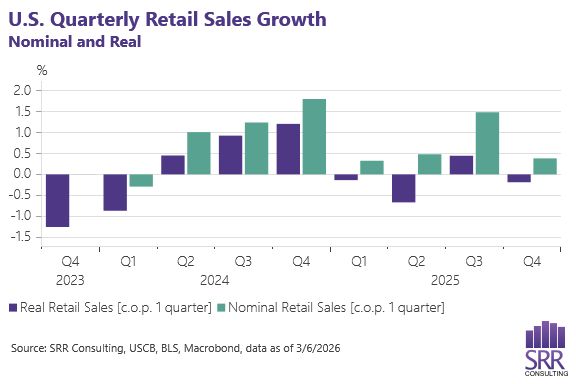
Past price increases do not disappear. Inflation compounds, and consumers are spending more to buy less. The final quarter of the year is typically strong for U.S. retail sales. Halloween spending kicks off the quarter, followed by Thanksgiving feast, and gift giving expenditures through late December.
Inflation hit hard in the fourth quarter of 2023, with no growth to speak of on a nominal basis. When adjusted for inflation (aka real), fourth quarter 2023 retail sales fell by 1.3 percent decline. In 2024, solid job gains combined with lower inflation allowed aggregate retail sales to expand on both a real and nominal basis, but 2025 was different.
The highest tariffs in a century changed the equation for shoppers and household budgets were tightened. Nominal retail sales eked out an 0.4 percent gain in the final quarter of 2025, but sales fell 0.2 percent when accounting for inflation. More was spent, less was purchased.
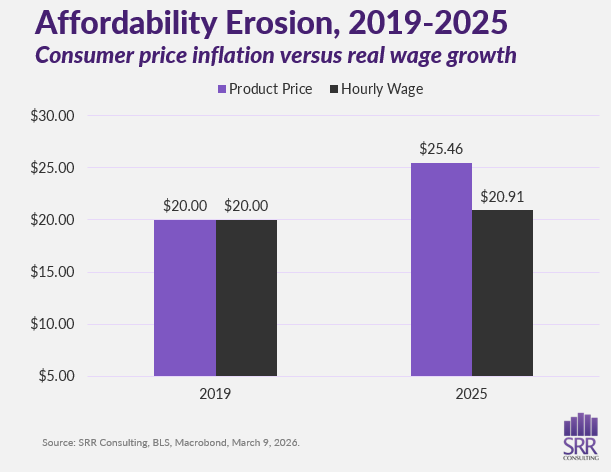
Affordability is eroding. I want to bring this into sharp focus with an example. A simple, $20-bill example of how compounding inflation drives a wedge between product costs and wages. Think for a moment about how you might spend an extra twenty bucks. Coffee mug? Silly socks? Ooh, I know what I’m buying… a bright red lipstick!
Now that you have a product in mind, let’s assume you have this extra $20 in 2019. From 2019 through 2025, consumer price inflation was a cumulative 27.3 percent. Thus, the $20 item in 2019 would cost $25.46 in 2025.
Next, let’s look at $20 as if it was your hourly wage. Wages have not grown as quickly as consumer prices. Median earnings of full-time wage and salary workers are up a cumulative 4.4 percent on a nominal basis since 2019, or 4.5 percent after accounting for inflation. That $20 per hour wage in 2019 would be $20.91 in 2025.
Positive real interest rates.
In January, the Federal Reserve’s Open Market Committee (FOMC) left the federal funds rate unchanged, at 3.50 to 3.75 percent, and I hope they stay put again next week. The FOMC meeting minutes did reveal concerns about “inflation running persistently” above target, including with respect to increased demand from tax cuts on high-income earners this year. The January meeting was a majority decision with two dissents from FOMC members who preferred a 0.25 percentage point cut, one from Miran, who still reports to the president, and the other Waller, who was on a shortlist to be nominated for Fed Chair. Kevin Warsh, a former Fed governor, has since been nominated to replace Chair Powell in May 2026.
Upward pressure on inflation will likely increase in 2026 with tariff impacts on retail goods ahead and tax cuts boosting demand from high-income and wealthy households. Easing monetary policy to appease the president increases the risk of hyperinflation. – Wednesday Wisdom 2/4
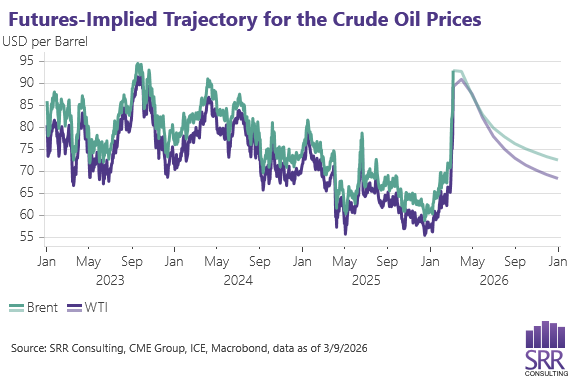
Geopolitical conflict often impacts oil prices. Past events have led to significant spikes in the spot West Texas Intermediate (WTI) crude oil price. Sixty-days after the 1990 Gulf War the WTI spot price increased fifty percent, and sixty days after the Russian invasion of Ukraine, the spot price increased by nineteen percent. One week after the February 28 strike on Iran, the WTI spot price is up 32.7 percent, to $89 per barrel as of March 6, 2026.
Oil price futures are still adjusting to the risk posed by the new war. As of March 9, the implied trajectory for oil prices shows a spike like the Ukraine war, up to $95 per barrel, with a quick drop to $70 per barrel by December 2026. A peak near $100 per barrel is a fair assumption, but I am doubtful the price will fall so rapidly.
War changes everything.
The U.S.-Israeli joint strike on Iran is expanding across the region, but you don’t need to take my word for it. The Economist1 estimates that 7.5 million people live within one kilometer of a reported strike across these fifteen countries. As of March 9, the following areas have been attacked:
Iran
Lebanon
Israel
Iraq
United Arab Emirates (UAE)
Bahrain
Kuwait
Saudi Arabia
Qatar
Jordan
Syria
Oman
Azerbaijan
Cyprus
West Bank
Iran is defending itself with infrastructure strikes across the region, including Saudi Arabian oil facilities and a water-desalination plant in Bahrain. Damaged natural gas liquefaction plants and oil refineries have been shuttered. Supply-chain disruptions are limiting food imports and energy exports. Air travel in the region is largely shut down.
Short-term oil price increases are the least of my worries. Long-term, structurally higher oil and natural gas prices are a larger concern. Lost capacity is not restored by flipping a switch. For the entirety of this conflict, supplies of twentieth-century fuel sources will be constrained, and when the conflict ends, repairing the damage will be necessary before energy flows are restored.
The U.S. under Trump has doubled down on oil and natural gas rather than moving into twenty-first century, reduced-carbon alternatives. This makes American consumers more vulnerable to rising costs from the conflict. After the invasion of Ukraine, Europe accelerated its energy transition while replacing Russian oil and gas with supplies from the Nordics and the UK, supporting their regional economies. The U.S. has considerable domestic supplies, particularly of natural gas, but the environmental damage has trade-offs for the climate and our health.
Outside of energy, I am concerned about financial markets and real estate values. Long-term U.S. Treasuries already face upward pressure from the OBBBA’s deficit expansion and the cost of repaying $180 billion in tariffs ruled illegal by the Supreme Court. The cost of waging war in Iran will have to be paid, and without Congressional approval to-date, it is unclear how it will be funded.
As of February 2026, the Congressional Budget Office estimates the fiscal year 2026 federal budget deficit to be $1.9 trillion, without including excess costs from the war. The deficit is expected to widen to $3.1 trillion over the next ten years, but that assumes continued moderation in inflation and steady economic growth. To put this in context, the deficit as a share of gross domestic product is nearly six percent this year, which is fifty-percent higher than the average since I was born.
The ten-year U.S. Treasury yield is over four percent and likely to trend higher amid growing geopolitical and domestic economic uncertainty. For real estate values, this means we’re back to higher-for-longer, for-longer. This nomenclature is trending toward silly, so I prefer a focus on positive real interest rates.
Short-term rates (aka the federal funds rate) should remain higher than the annual inflation trend. This would imply a cautious Fed that doesn’t cut rates until inflation is steady at its two-percent target and keeps rates at least as high as three percent. In addition to planning for positive real short-term rates, real estate investors should target total returns above long-term rates (aka the ten-year Treasury). Four percent cap rates don’t make sense in this environment.
So what?
The degradation of U.S. spending power is going to get worse. Energy prices for our utilities and transportation will rise. Depending upon the magnitude and duration of energy price increases, other product prices may rise on the transportation costs and/or shortages due to supply chain disruptions. Pandemic disruptions to trade are a fresh memory, but the next energy-driven inflation cycle will be layered upon the last, leaving us to pay an extra premium for even less stuff. With a weak labor market and tariffs added on, 2026 will be a tough year for us.
I wish I had better news, but facts are facts. Let’s hope (and demand from our representatives) the conflict, tariffs, deportations, and healthcare criminalization end asap.
Cheers! Sara ☀️
The Economist: Iran War Tracker, as of March 9, 2026.