
Wednesday Wisdom 6/10
Midweek reads full of fun facts to contemplate on the World Cup bump, misery, migration, and bedtime

Hello Readers,
I have been writing like the wind, enjoying longer sunny days, and avoiding social media. I hope you are finding time for joy despite ugly news and high prices, even if you stay up too late.

Big News
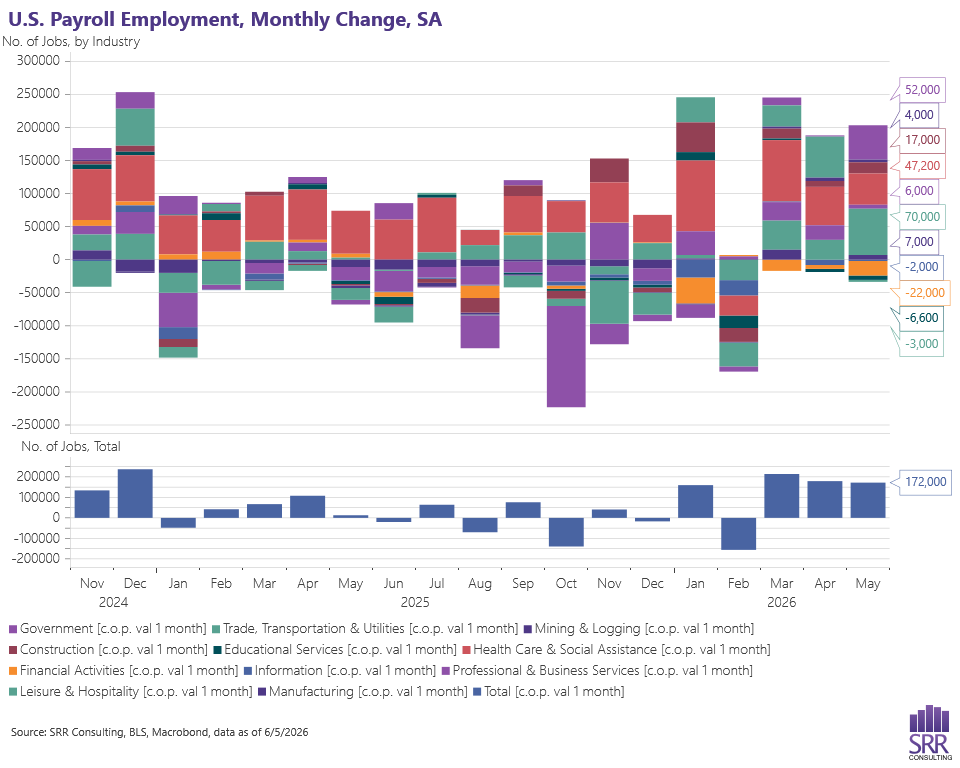
Employment jumped over the month in May 2026, adding 172,000 jobs. However, 87 percent of those jobs were added by just three industry sectors.
Local government led gains over the month, adding 55,000 jobs, with only one-fifth of those jobs in local education. With government spending concentrated on education and policing, the other 43,500 new jobs are likely related to policing. Total government employment (see chart below) was slightly lower due to losses in state education and federal employment.
Restaurants and bars added 48,000 new jobs in May. This hiring aligns with continued retail spending growth on food services as well as leasing in retail properties. Restaurant/bar job gains are a slice of the 70,000 jobs added in leisure and hospitality, with the remainder attributed to hotels and entertainment venues. Strength in this sector combined with local government hiring is likely World Cup-related bump.
With 47,200 new jobs in May, healthcare remains a top sector for growth. Job gains were broad across most roles, led by home care and social services.
Slight losses in skilled nursing and memory care/rehab facilities were offset by gains in retirement and assisted living facilities, allowing senior housing employment to expand overall. Senior housing is a top performer in commercial real estate given its undersupply of space, but staffing is fueled by immigration, so I will be watching this closely.
The unemployment rate is flat over the month and year, at 4.3 percent. Sideways movement in the unemployment rate coincides with people who want a job dropping out of the labor force, while the total employed and unemployed in the labor force trend together.
So what? The American people are miserable, and I can prove it.
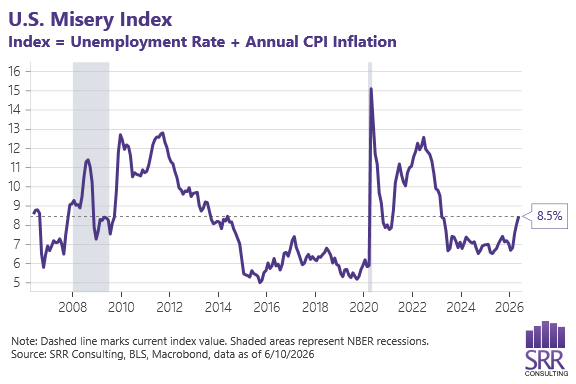
The Misery Index was a common metric during hyperinflation in the 1970s and 1980s, and sadly, it is worth our attention today. The index combines the current unemployment rate with trailing year CPI inflation.
Today’s stable unemployment and rising inflation have pushed the index to recessionary levels. There is no ‘vibe-cession,’ the economic misery is real.
Related Fun Facts Reads:


Reads Around the Web
H-1B Crackdown on Indian Workers Erodes a Texas Real Estate Boom, by Prashant Gopal and Tanaz Meghjani, Bloomberg, June 3, 2026: ”H-1B approvals in the Dallas area [exceed] Silicon Valley, Seattle, San Francisco and Washington, DC… Visa holders flocked to the new subdivisions spreading north through the suburbs of Prosper, Frisco and… Celina, where the population more than tripled in just five years… Indian buyers are disappearing from the market as federal and state governments tighten H-1B restrictions and many of the tech companies that employed the new arrivals fire workers in favor of artificial intelligence. Prices in the Collin County suburbs north of Dallas in February dropped almost 9% from a year earlier, compared with a decline of 4% in the metro area.“ (🎁link)
Meet the Rocket Barons Set to Make Millions (and, in Some Cases, Billions) From the SpaceX IPO, by Clara Molot, Vanity Fair, June 9, 2026: “Come Friday, the initial public offering of SpaceX, Elon Musk’s space-exploration-meets-AI mishmash company, is expected to mint around 4,000 new millionaires, multiple new billionaires, and potentially even turn its founder into the world’s first-ever trillionaire… If all goes according to plan, SpaceX will pocket $74.4 billion from the offering… because SpaceX, in typical Musk fashion, doesn’t play by traditional rules.”
The pain to come in private credit, by invitation - Hamza Lemssouguer, The Economist, June 1, 2026: “Low interest rates and the hunt for yield fuelled investment in private markets and encouraged capital structures optimised for cheap money and seamless exits… The long benign period in which debt-laden businesses were supported by globalisation has given way to an increasingly fragmented world, with its higher costs of doing business… It is a private-credit market defined less by outright distress and more by widening dispersion between winners and losers.” (🎁link)
Reads on Substack
“Data centers provide limited long-term economic benefits to communities because they create very few permanent jobs.”
“ICE’s own data confirms that he has no criminal history.”
“…in the real world, Medicaid work requirements are much more likely to worsen poverty than to reduce it.”


One Last Thing…
“I like dancing when they win.”
Sara’s Fun Facts Schedule
🦉 6/17 Wednesday Wisdom: Fed Day, late edition
🦉 6/24 Wednesday Wisdom: Inflation and Retail Sales
🦉 7/1 Wednesday Wisdom: JOLTS! (job opening and labor turnover survey)
☀️ 7/8 Sunshine Corner 7/2026
“The most revolutionary thing one can do is always to proclaim loudly what is happening.” — Rosa Luxemburg
Cheers! - Sara 🦉