
Wednesday Wisdom 7/22
Midweek reads full of fun facts to contemplate on credit card debt, solopreneurs, and what?

Hello Readers,
Summer is fabulous up here by Lake Michigan. Except for the smoke. I am allergic to mold, which comes with a long list of no-nos. Even though my phone says, “the air will kill you,” I step outside each morning to check. The temperature is perfect, the sun is shining, and the air is… nope. This smoke will pass, but it will happen again.
Among the reads this week, I’ve included a piece about the smoke and money fueling anti-science nonsense in my government. But first, let’s talk consumer credit.
Big News
To bring macro data into focus, I like to check-in on consumer credit conditions from time to time. How we spend is as important as how much we spend. However, this topic tends to play second fiddle to GDP and retail sales, until financed consumer spending becomes a problem.
Outstanding consumer credit (ahem, debt) totals $5.3 trillion as of May 2026, according to the Federal Reserve. Nearly three-quarters of this outstanding debt is nonrevolving, like a home mortgage or car loan, and the remaining $1.5 trillion is revolving credit card debt.
Credit card balances have increased by $50 billion over the past year. The tricky bit about this Fed data is that we can’t be sure how much of this change is accrued interest on balances versus new spending. However, we can see that delinquent balances are rising.
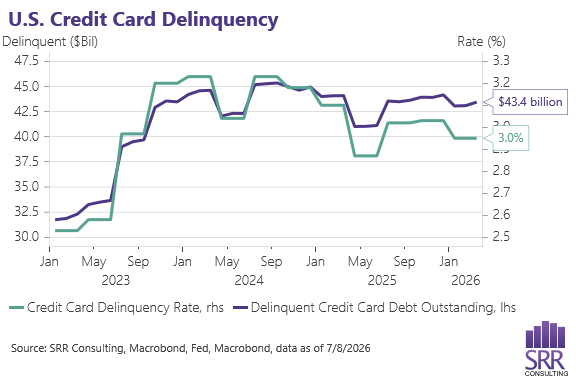
Credit card delinquency fell to historic lows during the pandemic, settling just below 1.5 percent. When interest rates began to rise in 2023, the delinquency rate quickly doubled and has held near three percent though the first quarter of 2026. Higher interest rates have pushed up the level of delinquent credit card debt, despite only small changes in the delinquency rate.
The Fed has not released the second quarter delinquency rate, yet. If we assume the rate holds at three percent, the increase in revolving credit card balances implies another billion dollars in delinquent debt during the second quarter.
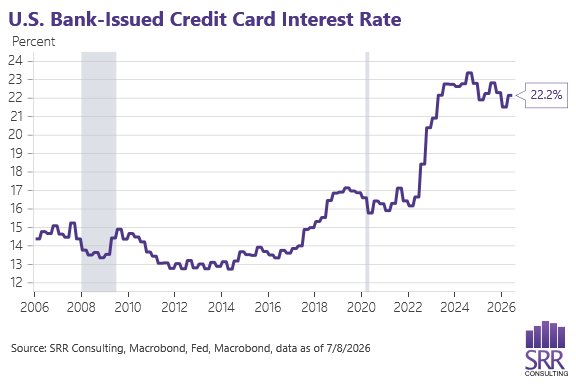
So what? American household budgets are stretched by inflation, and credit cards must be helping to fill the gap. Credit card balances, delinquent balances, and interest rates are up. Current policy has restricted employment growth and remains inflationary. Without relief, credit conditions will become a problem.
Related Fun Facts Reads:


Reads Around the Web
The Federal Minimum Wage Hits a Seven-Decade Low, by Sylvia Allegretto, Center for Economic Policy and Research, July 8, 2026: ”today the federal wage floor is officially a poverty wage… 20 states… have $7.25 as their minimum wage… most of the states that make up the Southern Region, which also have the highest shares (noted in parentheses) of their respective workforces earning below $15 per hour – including Alabama (18%), Arkansas (20%), Georgia (15%), Kentucky (18%), Louisiana (25%), Mississippi (26%), North Carolina (16%), Oklahoma (21%), South Carolina (16%), Tennessee (14%), and Texas (17%). These states have some of the highest rates of poverty in the country, and the lowest shares of their workforces represented by unions.”
Americans Pull Back on Retirement Savings as Everyday Expenses Climb, by Michelle Amponsah, Bloomberg, July 17, 2026: ”One-third of US workers with an employer-sponsored retirement plan reported having more credit-card debt than retirement savings… a comfortable retirement by [age] 65 is becoming out of reach for many Americans. That prospect seems particularly bleak with the Social Security trust fund projected to be depleted by 2032, which, absent government action, would mean significant cuts to promised benefits.”
America’s Enterprising Spirit Is Booming After Decades-Long Slump, by Sydney Ember, The New York Times, July 17, 2026: “Americans filed 5.7 million applications last year to start new businesses… the most in the two decades the government has kept track. New business applications through the first half of this year continued to climb… the rise in business applications has been driven by start-ups that are not likely to hire workers rather than by those that are. That, some economists believe, is more evidence that A.I. is eviscerating obstacles to entrepreneurship.” (🤓Read the paper - Prompted to Start: How Generative AI is Transforming Entrepreneurship)
If a paid subscription isn’t an option, consider a small, one-time tip to support my work and research costs.
Reads on Substack
“…evidence points toward a structural increase in genuine small business activity over 2025 and 2026, driven by solopreneurs.”
“…calling attention to climate change would require drawing attention to the industry primarily responsible. And that can’t happen. Because money.”
“…obligations to their jobs could not trump the pull to fight for a functional democracy in Ukraine.”


One Last Thing…
“What?!”
Sara’s Fun Facts Schedule
🦉 7/29 Wednesday Wisdom: Fed Day, afternoon edition
🦉 8/5 Wednesday Wisdom: Q2 GDP Growth
🦉 8/12 Wednesday Wisdom: July Jobs
🌆 8/14 SRR Real Estate Quarterly: Q2 2026
“If you wish to make an apple pie from scratch, you must first invent the universe.” — Carl Sagan
“The most revolutionary thing one can do is always to proclaim loudly what is happening.” — Rosa Luxemburg
Cheers! - Sara 🦉