
Wednesday Wisdom 7/29
Midweek reads full of fun facts to contemplate on the Warsh Fed, inflation, and stargate

Hello Readers,
Happy Fed Day! I listened to Chair Warsh’s press conference, and it was thin on specifics. I share my thoughts on today’s rate decision below with more monetary policy reading from me and around the web. Substack reads this week expand into immigration detentions, free speech, and economic systems. At the close, I share the weirdest thing I heard all week.

Big News
This afternoon, the Federal Reserve’s Open Market Committee (FOMC) voted to hold their benchmark rate at the 3.50 to 3.75 percent range. The decision was split with one-fourth of the committee members preferring a quarter-point hike.
I find it noteworthy that the dissents were made by three Federal Reserve Bank Presidents from Cleveland, Dallas, and Minneapolis. Bank presidents maintain strong connections with the industries and business leaders in their districts. Dissents from district bank presidents (as opposed to members of the Board of Governors) speaks to growing inflation concerns in their communities.
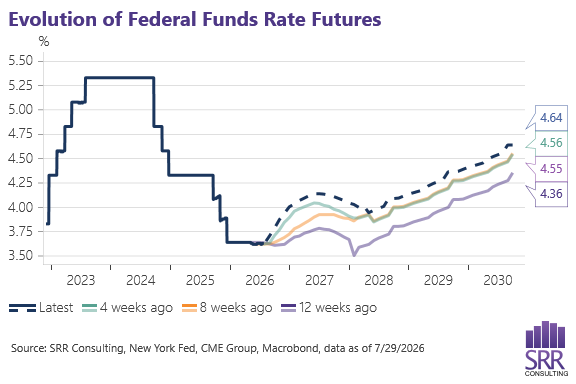
The FOMC statement is very short and stresses a commitment to price stability. Chair Warsh is expected to continue reducing public communication, although he assured us at today’s press conference that he will continue to hold press conferences through December 2026.
The press conference held little additional economic commentary, by design. Warsh is not interested in communicating with the general public about policy decisions or how current economic conditions are guiding those decisions. He did clarify that this FOMC’s inflation target is exactly two percent and tied to the personal consumption expenditure (PCE) measure from the GDP accounts.
Chair Warsh was also pleased to note how sharply U.S. Treasury yields increased without forward guidance from the June FOMC meeting:
“Nominal and real yields are materially higher across the Treasury curve. In fact, some of the increases in market interest rates between FOMC meetings are among the most significant in the last two decades… In the intervening period, market attention centered on real data and real economic developments. Prices reacted in real time to incoming information and the reduction in forward guidance may have been a factor. Market participants are learning to play the ball, not the referee, and market prices will continue to respond in the direction and magnitude they see fit. This is, in my view, a change for the better, and we’re just getting started.”
So what? Interest rates are going up, but Chair Warsh doesn’t want to say when.
I find this retro approach to monetary policy to be quite silly. After three decades of growing Fed transparency, a Fed Chair refusing to share their thinking on current economic conditions and the short-term outlook risks appearing ineffective to the American people, and Congress.
Related Fun Facts Reads:


Reads Around the Web
Alan Greenspan’s Death is a Chance to Remember the Heroism of his Most Powerful Critic, by Nathan Tankus, Notes on the Crisis, July 14, 2026: “Fed watchers are upset because… Kevin Warsh’s recent choice to back away from forward guidance… Nowadays ‘transparency’ is all the rage in monetary policy. This wasn’t always the case… Volcker infamously wouldn’t even admit that he was setting interest rates… Greenspan was a man under extreme pressure from Henry Gonzalez, a true zealot for government transparency… Today the Federal Reserve commentariat sees the regular release of FOMC meeting transcripts as extremely positive. Greenspan’s Federal Reserve resisted every step of the way.”
Speech: Economic Outlook, Federal Reserve Governor Lisa D. Cook, July 15, 2026: “Persistently elevated inflation imposes an unacceptable burden on American families, and it is the Federal Reserve’s responsibility to restore price stability… big supply shocks—tariffs and the Middle East conflict—risk leading to persistently higher inflation… these shocks come as inflation has been elevated relative to our target for five years. Firms’ pricing and wage decisions may depend more on what inflation has been rather than its source—implying a risk that the high inflation we have seen boosts inflation going forward.”
AI and the global economy: implications for central banks, by Iñaki Aldasoro et.al., Bank for International Settlements (BIS) Bulletin No. 130, July 28, 2026: “considerable uncertainty surrounding the effects of AI raises several challenges for monetary policy and financial stability… AI simultaneously affects demand and supply, in both cyclical and structural ways… the effects differ across sectors, complicating the assessment of underlying trends. Strong activity may reflect temporary demand factors… rather than sustained increases in potential output, while productivity gains are uneven and hard to measure. The AI boom may thus alter key unobservable benchmarks, including the natural rates of interest and unemployment, frequently used in monetary policy analysis.”
If a paid subscription isn’t an option, consider a small, one-time tip to support my work and research costs.
Reads on Substack
“…this is how many people are pulled out of the U.S. workforce given that the vast majority of people are of working age”
“When people cannot gather and share information in these online spaces, it’s very much a threat to our democracy.”
“The names and labels we are applying right now belong to an earlier era.”


One Last Thing…
Sara’s Fun Facts Schedule
🦉 8/5 Wednesday Wisdom: Q2 GDP Growth
🦉 8/12 Wednesday Wisdom: July Jobs
🌆 8/14 SRR Real Estate Quarterly: Q2 2026
😎 8/19 Sara Takes a Vacay: No Wednesday Wisdom
“Be loud for America.” — Governor JB Pritzker
“The most revolutionary thing one can do is always to proclaim loudly what is happening.” — Rosa Luxemburg
Cheers! - Sara 🦉